Seongnam Arts Center seat views and parking — is the Opera House 1,808 seats or 1,804?
Parking at 성남아트센터 (Seongnam Arts Center) costs 2,000 won for a small car for up to five hours including the performance if you show your ticket; without a ticket it is free for 39 minutes, then 300 won per 10 minutes up to a 6,000 won daily cap. The Opera House is described as an 1,808-seat hall, but adding the seat counts printed on the venue's own floor plans gives 1,128 + 404 + 272 = 1,804 — the same figure KOPIS registers.
PUBLICAi Editorial Team11 min read
At a glance
- Facilities
- Seongnam Arts Center
- Address
- 경기도 성남시 분당구 성남대로 808 (야탑동)
- Seats
- 3,381

Contents13
- How much does parking cost at Seongnam Arts Center?
- Who gets a parking discount?
- Where are the pre-payment machines?
- How many parking spaces are there, and where?
- Which Opera House stalls seats have the best view?
- What about the Opera House first and second balconies?
- Where does the Concert Hall sound best?
- What kind of theatre is the Ensemble Theater?
- How do wheelchair seats and the visitor facilities work?
- Do the KOPIS seat counts match the official ones?
- How do you get to Seongnam Arts Center by subway?
- When can you cancel a booking, and what does it cost?
- In short
Parking at 성남아트센터 (Seongnam Arts Center) costs 2,000 won for a small car for up to five hours including the performance if you show your ticket; without a ticket it is free for 39 minutes, then 300 won per 10 minutes up to a 6,000 won daily cap. The Opera House is described as an 1,808-seat hall, but adding the seat counts printed on the venue's own floor plans gives 1,128 + 404 + 272 = 1,804 — the same figure KOPIS registers.
성남아트센터 is the Seongnam Cultural Foundation's arts complex at 808 Seongnam-daero, Bundang-gu, Seongnam, Gyeonggi-do, open since 2005. KOPIS, Korea's performing-arts registry, lists four halls under 성남아트센터 (FC000016) — 오페라하우스 (Opera House), 콘서트홀 (Concert Hall), 앙상블씨어터 (Ensemble Theater) and 미디어홀 (Media Hall) — totalling 3,381 seats. This guide answers the two questions people search for just before booking, "what will parking cost" and "will I see the stage from this seat", by checking the foundation's official pages against the KOPIS record. Figures are as of September 2026.
How much does parking cost at Seongnam Arts Center?
Show your performance ticket and it is 2,000 won for a small vehicle or 4,000 won for a large one, covering up to five hours including the performance. Without a ticket the first 40 minutes cost 400 won — though the first 39 minutes are free — and each further 10 minutes costs 300 won, capped at 6,000 won a day. Exhibition visitors who show an exhibition ticket pay 1,000 won for up to two hours.
| Category | Small (under 5t, up to 35 seats) | Large (5t+, 36 seats or more) | Notes |
|---|---|---|---|
| Base (first 40 min) | 400 won | 800 won | Free up to 39 minutes |
| Each additional 10 min | 300 won | 600 won | Base + additional beyond 40 minutes |
| Daily maximum | 6,000 won | 12,000 won | — |
| Monthly pass | 50,000 won | Not available | External monthly parking |
| Performance ticket holders | 2,000 won | 4,000 won | Up to 5 hours including the performance |
| Exhibition ticket holders | 1,000 won | 2,000 won | Up to 2 hours |
The 39-minute free window is stated in the official notice exactly as written above. Dropping in briefly to collect a ticket costs nothing.
Who gets a parking discount?
There are four categories and they cannot be combined. Each one is checked against a certificate or a windscreen sticker.
| Who | Discount | Proof |
|---|---|---|
| National merit holders, May 18 Democratic Movement injured, Agent Orange patients, war veterans, independence patriots | Free within 12 hours, 50% beyond 12 hours | Merit certificate or booklet |
| Disabled drivers, light cars (under 1,000cc), low-emission cars (hybrid, electric), pregnant drivers, families with two or more children under 18, distinguished military service families | 50% | Certificate or sticker |
| Electric vehicles | Free within 2 hours | Proof of charging |
| Drivers commended as model taxpayers | Free within 24 hours | Commendation certificate |
The last row is the one most other guides leave out: a car whose owner has been commended as a model taxpayer parks free for up to 24 hours. Parking is also free of charge on Children's Day (5 May) and on Seongnam Citizens' Day (8 October).
Where are the pre-payment machines?
Each hall has its own, and only the Opera House has three. Settling up before the performance or during the interval avoids the queue at the exit barrier when everyone leaves at once.
| Hall | Pay-station locations |
|---|---|
| 오페라하우스 (Opera House) | 1F lobby / B1 car park / B2 car park (by the lift) |
| 콘서트홀 (Concert Hall) | 1F lobby / B1 (by the lift) |
| 앙상블시어터 (Ensemble Theater) | 1F lobby |
| 큐브플라자 (Cube Plaza) | Entrance to Cube Art Museum, 1F |
Parking enquiries go to 031-783-8000 or 031-783-8296.
How many parking spaces are there, and where?
There are 717 in total, a figure that includes 15 accessible bays. They sit in three separate car parks, so which entrance you want depends on which hall you are going to.
| Car park | Spaces | Breakdown |
|---|---|---|
| Outdoor | 335 | Includes 11 around the building |
| Opera House | 238 | B1 55 · B2 183 |
| Concert Hall | 144 | B1 52 · B2 60 · outdoor 32 |
The foundation's own parking notice says plainly that "given the size of the auditoriums the parking area is cramped; please use the subway or public transport where possible". The Opera House alone seats 1,804 against 717 spaces for the whole complex. For a weekend evening performance, allow 30 minutes to an hour.
Which Opera House stalls seats have the best view?
The 1,128 stalls seats run from row 1 to row 24 and split into three blocks: A on the left (seats 1–16), B in the centre (17–32) and C on the right (33–48). A cross aisle between rows 16 and 17 divides the front block (rows 1–16) from the rear block (rows 17–24), and the back wall carries 18 accessible seats, numbered 1–9 on the left and 10–18 on the right.

An orchestra pit sits between the stage and row 1, so the front row is not right against the stage. Row 1 on the left begins at seat 6 and the rows lengthen towards the back, so the same seat number sits differently in each row. Every view photo below comes from the foundation's official seating-chart page, with the seat name printed across the top of the image.


The centre B block faces the stage square on, whether in front of the aisle or behind it. The outermost numbers look at the stage on the diagonal and take in the side walls.


What about the Opera House first and second balconies?
The first balcony holds 404 seats and the second 272. The first balcony runs from row 1 to row 10 plus side boxes L1–L6 and R1–R6; the second runs from row 1 to row 7 with side boxes numbered the same way. A box row holds three seats, so its numbers stop at 3 — only L1 and R1 on the first balcony run 01 to 07.


The side boxes look down at the stage from an angle, so part of the upstage area can be hidden. If the staging itself is the point, a centre row is the better buy at the same price.


The second balcony is high enough to take in the whole stage picture at once, at the cost of faces. It suits orchestral and choral programmes where the layout matters more than expressions.


Where does the Concert Hall sound best?
The Concert Hall is an arena-form room built for music with no proscenium curtain, and it was designed for a 1.8-second reverberation time. The 668 stalls seats run from row 1 to row 14, numbered 1–12 on the left, 13–32 in the centre and 33–44 on the right, with a cross aisle between rows 8 and 9. The 12 accessible seats at the back are numbered 1–6 on the left and 7–12 on the right.

Row 1 looks up at the platform. With no curtain the players feel very close, but in large forces the front desks reach you first.


From row 9, behind the aisle, the whole platform fits in one frame. Even within a single row, seat 1 and seat 44 see very different angles.


The 318 balcony seats run from row 1 to row 7 plus side blocks L1–L3 and R1–R3, and rows C1 to C3 behind the platform are the choir stand. Those seats are sometimes sold when no choir is performing; they face the conductor head-on, but you see a soloist's back.


The same concert sounds different in the two halls. The Opera House is a multipurpose room with eight acoustic banner curtains and electronic assistance that moves reverberation from a base of 1.6 seconds up to 3 seconds; the Concert Hall is a dedicated room fixed at 1.8.
What kind of theatre is the Ensemble Theater?
It is a 378-seat studio with a 132m² main stage. Rows run from 1 to 20, with a cross aisle between rows 9 and 10 dividing a front block (rows 1–9) from a rear block (rows 10–20). The rear block fits more seats per row, and the five accessible seats sit beside row 7 on the left.
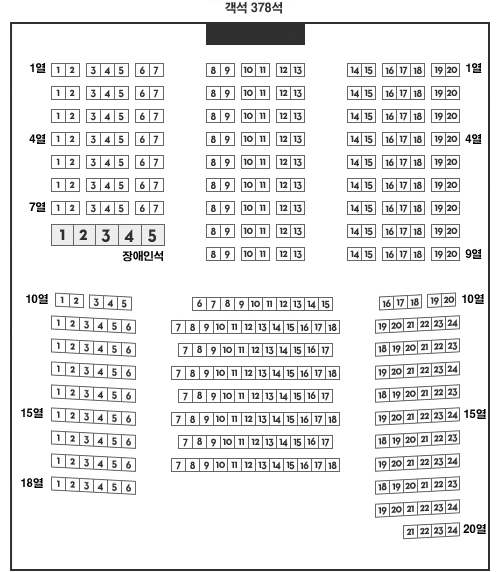
A T-shaped thrust extension and a revolve on the main stage mean the front rows can be reconfigured for a given production. If the seat map on the booking page differs from the plan above, that production has pushed the stage out into the house.


How do wheelchair seats and the visitor facilities work?
There are 18 accessible seats at the back of the Opera House stalls, 12 at the back of the Concert Hall stalls and five beside row 7 of the Ensemble Theater. Wheelchairs are kept at each hall's cloakroom, lent first to people who booked ahead, and you need photo ID to borrow one (i-Plaza, 031-783-8000). Each hall also keeps a voice amplifier for deaf and hard-of-hearing visitors and an evacuation chair for use on the stairs.
With children, head for the Opera House ground floor. Opposite the box office, the 아이사랑방 childcare room covers 43.5m², takes 15 children at a time, and looks after the children of that day's audience aged 3 (36 months) to 7 free of charge. It opens an hour before curtain and closes 30 minutes after the performance ends, by advance booking on 031-783-8288. Under 36 months, use the nursing room beside the box office. The cloakroom, nursing room, box office and playroom are all on that same Opera House ground floor.
Do the KOPIS seat counts match the official ones?
One hall of the three differs, and that hall's own figures disagree with each other.
| Hall | Foundation hall page | Sum of the floor plans | KOPIS record |
|---|---|---|---|
| 오페라하우스 (Opera House) | 1,808 | 1,804 (stalls 1,128 + 404 + 272) | 1,804 |
| 콘서트홀 (Concert Hall) | 1,102 | 986 (stalls 668 + balcony 318) | 1,102 |
| 앙상블시어터 (Ensemble Theater) | 378 | 378 | 378 |
| 미디어홀 (Media Hall) | Not listed as a hall | — | 97 |
The hall page calls the Opera House an 1,808-seat theatre, but adding the seat counts printed on the same site's three floor plans gives 1,804. Each plan's header repeats "(1,808석)" alongside its own figure, so the plans alone cannot say which floor the missing four seats belong to. The KOPIS record agrees with the plans at 1,804.
The Concert Hall runs the other way. Its 1,102 total is the same on the hall page and in KOPIS, but the floor plans give 668 in the stalls and 318 in the balcony — 986, so 116 seats are unaccounted for. The choir stand behind the platform is not counted in either floor's figure.
미디어홀 is a space the foundation describes as a meeting room rather than a performance hall. It is on the third floor of 큐브플라자, measures 150m² with 97 seats, opens 10:00–18:00, and is reached on 031-724-8356. KOPIS holds the same 97 seats and 150m² but files it as a performance venue. If your ticket says 미디어홀, it is in a different building from the Opera House and the Concert Hall, so check the route first — and that is also why 큐브플라자 appears in the parking pay-station list.
The accessible seats match exactly in all three halls. The plans show 18 in the Opera House (9 left, 9 right), 12 in the Concert Hall (6 left, 6 right) and 5 in the Ensemble Theater, and KOPIS records the same 18, 12 and 5.
How do you get to Seongnam Arts Center by subway?
It is about a 10-minute walk from exit 1 of Imae station on the Suin-Bundang and Gyeonggang lines. The address is in Yatap-dong, so Yatap station comes to mind first, but the walking route the foundation publishes starts at Imae. From Yatap, Moran or Seohyun you change to a bus.
| Mode | Route | Stop |
|---|---|---|
| Rail | Imae station (Suin-Bundang, Gyeonggang), exit 1 | About 10 minutes on foot |
| Express bus | 9408, 3330, 4000, 9607 | Arts Center |
| Local bus | 17, 17-1, 33-1, 51, 119, 119-1, 220, 250, 300, 375, 720-1A, Nuri 1 | Arts Center |
| Interchange | Yatap exit 4 · Moran exit 7 · opposite AK Plaza at Seohyun | Arts Center |
Coming from Pangyo on the Shinbundang line, take 4000, 375 or Nuri 1 from the east-side stop, or 3330 from the Nakseong overpass stop.
When can you cancel a booking, and what does it cost?
There is no cancelling on the day, and for a Sunday performance the deadline is 11:00 on the Saturday. For performances Monday to Saturday and on public holidays, you can cancel or change until 17:00 the day before.
| When you cancel | Fee |
|---|---|
| Within 7 days of booking | None |
| Up to 10 days before the performance | 4,000 won for musicals, concerts, classical and dance; 2,000 won otherwise (capped at 10% of the ticket) |
| 9 to 7 days before | 10% of the ticket |
| 6 to 3 days before | 20% of the ticket |
| 2 to 1 days before | 30% of the ticket |
Booking on the venue's own website carries no booking fee; booking by phone on 1544-8117 costs 2,000 won a ticket. In person, i-Plaza on the Opera House plaza sells tickets 09:00–18:00 (closed 12:00–13:00), and from 90 minutes before curtain the box office in that hall's own lobby takes over. If you booked at a discount, the person attending must present the proof themselves to collect the ticket.
In short
- Parking comes down to producing your ticket: 2,000 won for five hours with one, 6,000 won for the day without. The pay stations are in the Opera House 1F lobby, B1 and B2; the Concert Hall 1F lobby and B1; and the Ensemble Theater 1F lobby.
- In the Opera House stalls the blocks are A 1–16, B 17–32 and C 33–48, with a cross aisle between rows 16 and 17. In the Concert Hall the centre is 13–32 and the aisle falls between rows 8 and 9. In both, the centre block in front of the aisle is the safe choice.
- Two Opera House capacities are in circulation, 1,808 and 1,804. The floor plans and KOPIS both say 1,804, and the accessible-seat counts — 18, 12 and 5 — match between the plans and KOPIS in all three halls.
Performance listings and per-hall seat counts are on the Seongnam Arts Center venue page, and seating and parking guides to other venues are collected under visiting tips.
Figures were checked in September 2026 against the Seongnam Cultural Foundation's official pages — parking, the halls, seating charts, meeting rooms, visitor facilities, public transport and booking — and against the KOPIS record. The seating charts and seat-view photographs are quoted from the foundation's official seating-chart page with the source named, and the seat names are copied from the labels printed on the images themselves. Rates and operations change, so call 031-783-8000 (parking 031-783-8296) before you go.


